

Paper Mailers for Higher-Value Products: Why MBOSS Makes Commercial Sense
When you send thousands of orders, the price of every paper mailer matters. Even a small difference becomes significant across a busy despatch operation.
However, when those orders contain higher-value products, the cost of packaging failure matters considerably more.
A damaged item can mean a replacement product, another delivery charge, additional packing time and a customer service conversation. It can also undermine the confidence of a customer who expected their purchase to arrive in perfect condition.
For a high-volume sender, the question should therefore be:
Which paper mailer gives us the best cost per successful, undamaged delivery?
MBOSS embossed paper mailers offer a compelling answer through their three-ply construction, embossed paper inner layer and design without a bottom seam. These are practical features to consider when selecting protective packaging for valuable orders.

Not All Paper Mailers Provide the Same Protection
“Paper mailer” describes a broad category of packaging. It does not tell you how much protection a particular product provides.
A simple paper mailing bag, a rigid cardboard envelope and an all-paper padded mailer perform different jobs. Before comparing prices, you need to understand which risks your product faces.
For higher-value goods, those risks might include surface scuffing, localised impact, movement inside the packaging or damage to the product’s retail presentation box.
The right choice depends on the complete packed order: its weight, shape, edges, fragility and journey through the delivery network.
A mailer that works well for a soft garment may be unsuitable for a compact item with hard corners. Equally, a rigid envelope may provide useful bending resistance while offering insufficient cushioning for a particular product.
Comparing paper mailers on price alone overlooks the differences that determine whether an order arrives in saleable condition.
Why the Embossed Paper Structure Matters
MBOSS uses an embossed paper inner sheet instead of a plastic bubble liner, within a three-ply paper construction.
Embossing gives paper a three-dimensional profile. In packaging terms, this introduces a structured layer between the contents and the outside of the mailer, rather than relying entirely on a flat paper wall.
For a sender, the important distinction is between packaging that simply contains an item and packaging that also provides a protective layer around it.
That makes MBOSS particularly relevant when evaluating a move from basic paper mailing bags to a padded paper format.
The level of protection still needs to be assessed with the actual product. Embossed paper cushioning does not make a flexible mailer a substitute for every rigid box, nor does it remove the need for additional protection where an item is especially fragile.
The commercial advantage comes from matching the protective construction to the order, without adding unnecessary packaging.
A Design Without a Bottom Seam Removes One Potential Failure Point
Seams and closures deserve close attention when assessing a paper mailer.
The paper itself is only one part of the packaging system. During handling, the contents can place stress on joints, particularly when an item is relatively heavy, tightly packed or has pronounced corners.
MBOSS is manufactured without a bottom seam. Its manufacturer identifies this as a structural improvement that reduces potential weak points.
For a high-volume sender, this is a useful design distinction. A protective inner layer has limited value if the package opens or loses its contents during transit.
When comparing samples, examine the whole construction: the body, remaining seams, opening and sealed flap. Assess how the packed mailer behaves when the product shifts or presses against an edge.
Reliable delivery depends on the integrity of the complete package.
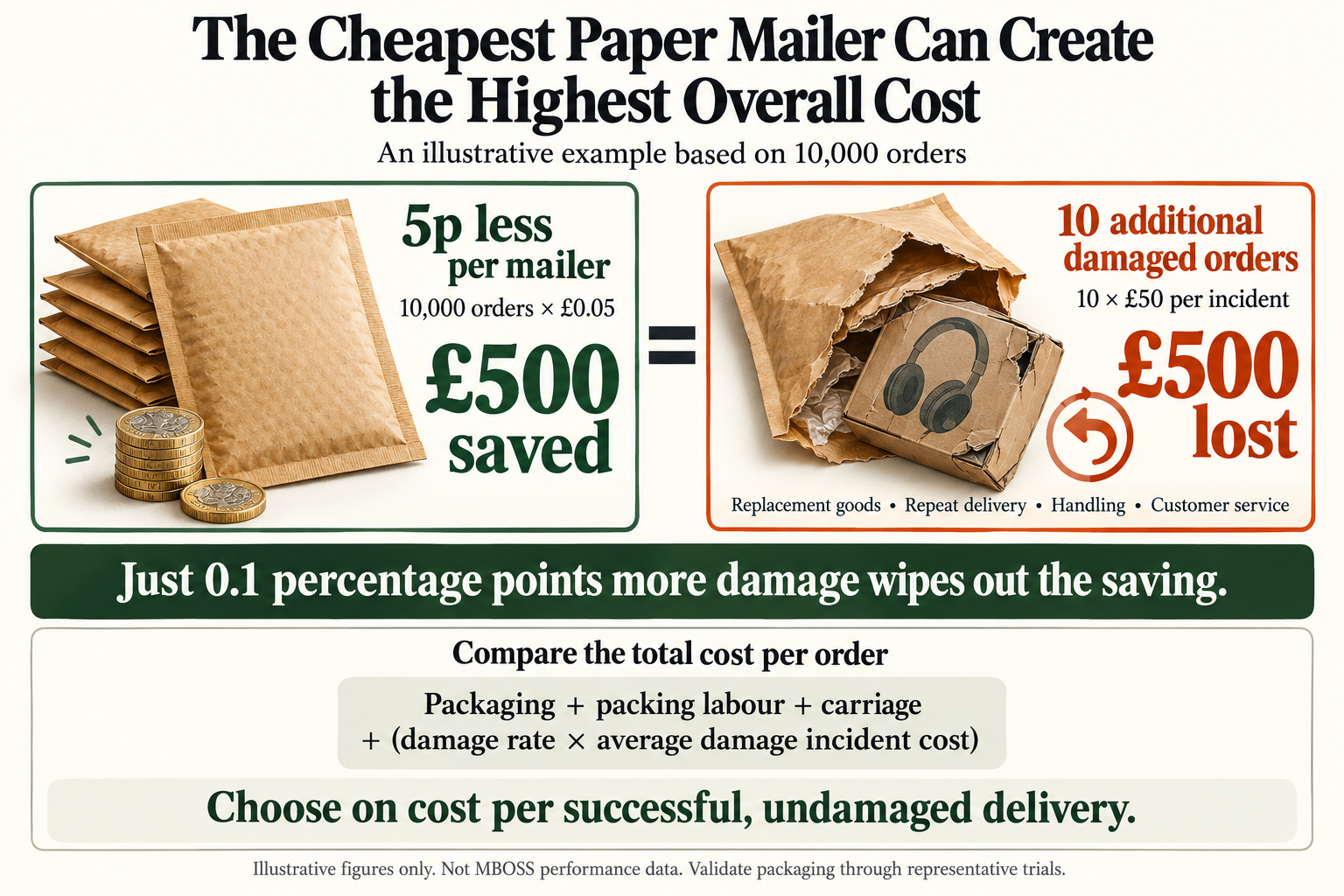
The Cheapest Paper Mailer Can Create the Highest Overall Cost
Consider an illustrative operation sending 10,000 orders.
A basic mailer costs 5p less per order, saving £500 on packaging purchases.
Now assume that each damaged order costs the business £50 in replacement goods, repeat delivery, handling and customer service. Just ten additional damaged orders would consume that entire £500 saving.
That is an increase in the damage rate of only 0.1 percentage points.
These figures are an example, rather than MBOSS performance data, but they demonstrate why purchase price needs to be considered alongside delivery outcomes.
A useful calculation is:
Expected cost per order = packaging + packing labour + carriage + damage rate × average cost of a damage incident.
For higher-value goods, the final part of that calculation can carry considerable weight.
A modest increase in packaging expenditure may be commercially justified if a representative trial demonstrates a sufficient reduction in damage.
Correct Sizing Is Part of Product Protection
An oversized mailer can leave room for the contents to move. An undersized one can place unnecessary strain on the material and closure.
Neither is an ideal starting point for a consistent packing process.
MBOSS offers standard stock sizes alongside bespoke sizing options. This gives senders an opportunity to select packaging around their products and order profiles.
For a high-volume operation, sizing should account for more than whether the item fits through the opening. Check the usable internal space once the product is inserted, the clearance around corners and the flap overlap needed to achieve a secure seal.
It may be more effective to use several carefully selected sizes than to force every order into one universal format.
The objective is a repeatable pack that protects the product and is straightforward for the despatch team to assemble correctly.
Weight Savings Are Useful When Protection Is Maintained
Packaging weight can affect carriage costs, particularly where a packed order sits close to a charging threshold.
MBOSS describes its construction as lighter than heavier macerated-paper padded mailers. This makes it worth evaluating where packaging weight is a concern. Actual postage savings depend on the finished parcel and your carrier’s charging structure.
Weigh the complete order, including the product, mailer, labels and any additional protection. Then check its packed dimensions.
A lighter mailer only creates a direct carriage saving if it changes the applicable charge. Nevertheless, avoiding unnecessary packaging weight can remain useful across a large despatch operation.
The priority is to achieve that efficiency while retaining the protection the product requires.
An All-Paper Format Supports a Simpler Customer Experience
Packaging also forms part of the customer’s experience after delivery.
MBOSS uses an all-paper padded construction without a plastic bubble liner, and the manufacturer states that its mailers can be recycled with household paper waste.
For brands moving towards paper packaging, this provides a practical alternative to a paper outer combined with a plastic cushioning layer.
However, recyclability should sit alongside product protection in the purchasing decision. A damaged product can require another item and another delivery, as well as generating additional packaging.
The strongest solution combines an appropriate material choice with reliable performance for the product being sent.
How to Compare MBOSS Against Your Existing Paper Mailers
Before changing packaging across a high-volume operation, run a controlled trial.
Use representative products, including the heaviest items, those with the most demanding corners and those whose retail packaging is most easily marked.
Compare:
- Packed condition: Does the product sit securely without excessive movement or strain?
- Closure performance: Can staff achieve a consistent seal during normal packing?
- Handling protection: Do the contents and retail packaging remain acceptable after representative handling?
- Packing efficiency: How long does each order take, including any additional wrapping?
- Delivered results: What damage, complaints and replacements occur during a live delivery trial?
- Overall cost: What is the combined cost of packaging, labour, carriage and failures?
Where the value or fragility of the product warrants it, commission appropriate transit testing.
Assess both the product and its presentation packaging. A technically functional item can still disappoint a customer if its retail box arrives crushed or scuffed.
Why MBOSS Deserves a Place on Your Shortlist
For businesses sending higher-value products in volume, MBOSS brings together several relevant design choices: embossed paper padding, three-ply construction, no bottom seam and a choice of sizes.
These features make it a strong candidate for senders seeking more protection than a basic paper bag while retaining an all-paper mailing format.
The best paper mailer for your business is the one that proves suitable for your products and delivery conditions.
Choose on the cost of getting the order there successfully, because a small packaging saving quickly loses its value when the product arrives damaged.
Put MBOSS Paper Mailers to the Test
Compare MBOSS with your current packaging using the products you actually send.
Request a MBOSS sample pack or call 01507 528769 to discuss your product sizes, order volumes and protection requirements.